Excerpt
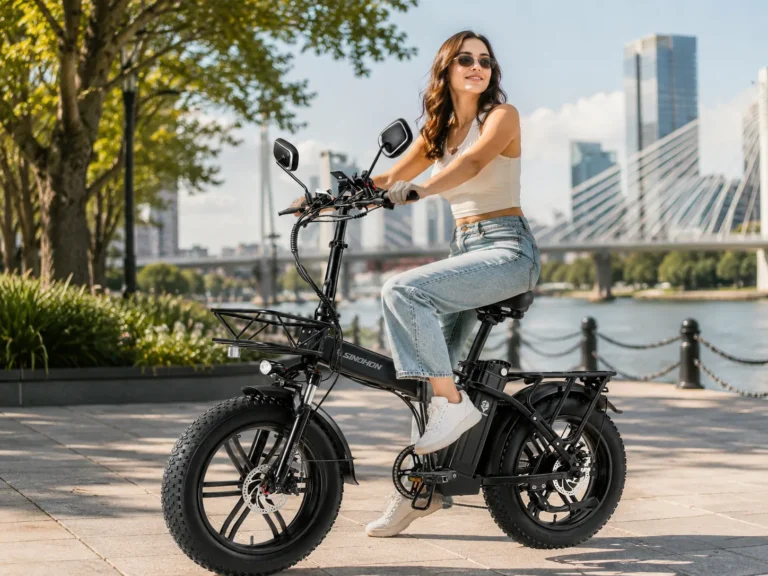
A 20-inch folding fat tire e-bike can be a practical choice for riders who want stable daily riding, easier storage, and utility for commuting or errands. This guide explains how to compare battery range, torque, frame style, tires, brakes, and everyday use cases before choosing a model.
Blog Content
Choosing an electric bike is easier when you start with how you actually ride.
Some riders need a bike for short trips around the neighborhood. Some need a practical commuter for daily city routes. Others want a folding frame that can fit better in an apartment, garage, van, or shared storage space. For many everyday riders, a 20-inch folding fat tire e-bike sits in a useful middle ground: compact enough to store more easily than a full-size bike, but stable enough for mixed city surfaces, park paths, and light gravel.
If you are comparing models like the SINOHON A20 and SINOHON B20, the key is not only looking at one headline specification. Battery capacity, frame access, tire size, torque, braking hardware, and real riding conditions all matter.
This guide walks through the main details to check before choosing a 20-inch folding fat tire electric bike.
1. Start With Your Daily Riding Scenario
Before comparing specifications, think about your most common riding pattern.
If your trips are longer and you want more battery capacity, range becomes one of the most important details. If your route includes frequent stops, parking, shopping, or mounting and dismounting often, frame access may matter more. If you ride on imperfect pavement, park paths, compact gravel, or uneven city surfaces, wider tires and front suspension can help create a more stable riding feel.
A folding fat tire e-bike is usually best for riders who want one bike for multiple daily jobs:
- Commuting to work or school
- Running local errands
- Riding through parks or riverside paths
- Carrying light daily items
- Storing the bike in a smaller space
- Using one bike across pavement, bike lanes, and light mixed surfaces
It should still be positioned correctly. A 20 x 4.0 fat tire e-bike can support mixed everyday surfaces, but it should not be described as an extreme off-road or downhill bike unless the model has been tested and certified for that purpose.
2. Compare Frame Style: Standard Folding vs Low-Step
Frame style affects how easy the bike feels before you even start riding.
A standard folding frame, such as the SINOHON A20, is a good fit for riders who want a utility-style folding fat tire e-bike with strong storage practicality and longer daily range positioning. It works well for riders who are comfortable stepping over a more traditional frame shape.
A low-step folding frame, such as the SINOHON B20, is designed for easier mounting and dismounting. This can be helpful for riders who stop often, carry items, ride in city traffic, park frequently, or simply prefer a lower step-over height.
If you are choosing between the two, ask yourself:
- Do I mount and dismount often during a ride?
- Do I carry bags or light cargo?
- Do I prefer easier access over a larger listed battery capacity?
- Will another family member also use the bike?
For frequent city stops and easier access, a low-step model can feel more natural. For longer range positioning and a more traditional folding utility setup, a model like A20 may be the better direction.
3. Look at Battery Capacity and Range Carefully
Battery and range are important, but range should always be explained honestly.
The SINOHON A20 uses a listed 48V 15.6Ah lithium battery. Its confirmed parameter sheet lists 60-80 km in pure electric mode and 80-110 km with pedal assist.
The SINOHON B20 uses a listed 48V 13Ah lithium battery. Its confirmed parameter sheet lists 60-80 km in pure electric mode and 80-100 km with assistance.
These numbers are useful for comparison, but real-world range can change based on:
- Rider weight
- Cargo weight
- Tire pressure
- Road surface
- Wind and temperature
- Assistance level
- Speed setting
- Stop-and-go riding
- Maintenance condition
If your priority is longer riding between charges, A20 has the larger listed battery capacity. If your riding is mostly city-based with frequent starts and stops, B20 may still be practical because it combines a low-step frame with strong torque and a useful daily range profile.
4. Check Motor Power and Torque
Motor power tells only part of the story. Torque also matters, especially when starting from a stop or riding gentle inclines.
Both A20 and B20 use a high-speed brushless 500W motor in the confirmed specification sheets. A20 is listed with 55 Nm torque, while B20 is listed with 75 Nm torque.
That gives B20 a stronger torque figure in the current SINOHON A20, B20, and C20 comparison set. This is useful for city starts, bridge approaches, and mild inclines. Still, the public copy should avoid extreme climbing claims unless there is separate test data.
For most daily riders, torque is most noticeable when:
- Starting from traffic lights
- Restarting after a stop
- Riding with light cargo
- Moving through slightly uneven routes
- Handling gentle slopes
If your route includes many stops, the higher torque rating of B20 may be attractive. If your priority is longer battery capacity and utility riding, A20 remains a strong choice.
5. Understand the Role of 20 x 4.0 Fat Tires
Both A20 and B20 use 20 x 4.0 fat tires. This is one of the main reasons these bikes feel different from a lightweight narrow-tire city folder.
Fat tires provide a wider contact patch. This can help with stability on pavement, bike paths, park roads, compact gravel, and imperfect urban surfaces. They also visually match the utility character of these models.
However, wider tires are not magic. They do not turn a commuter e-bike into a professional off-road machine. The best positioning is practical mixed-surface riding, not extreme terrain.
A good public description would be:
“Designed for city streets, bike paths, park routes, compact gravel, and light mixed surfaces.”
A claim to avoid unless tested:
“Built for extreme mountain trails.”
That difference matters for customer expectations and compliance.
6. Do Not Ignore Brakes, Gears, and Suspension
A useful everyday e-bike is not just about motor and battery.
The A20 and B20 parameter sheets list Shimano 7 Speed transmission and front and rear mechanical disc brakes. A familiar gear system helps riders adapt to flats, starts, and varied routes. Mechanical disc brake hardware supports daily braking control.
Source images also show front suspension and practical commuting hardware such as fenders, lights, mirrors, and racks. Before publishing accessory-specific claims, final retail configuration should be confirmed, because accessories can vary by market, SKU, or batch.
For a product page or blog, it is safer to say:
“Source images show racks, fenders, lighting, mirrors, and front suspension. Final accessory configuration should be confirmed before purchase.”
This keeps the copy useful without overpromising.
7. Think About Storage and Handling
A folding frame is one of the biggest reasons to choose this type of e-bike.
Folding does not mean the bike becomes tiny, and folded dimensions should be confirmed before making car trunk or RV storage claims. But a folding frame can still make storage easier for apartments, garages, vans, elevators, and shared storage spaces.
Weight also matters. A folding fat tire e-bike with a 48V system, racks, wide tires, and larger frame hardware will usually feel more substantial than a compact lightweight city folder. Riders should consider whether they need to lift the bike frequently or mostly roll and store it.
If portability is the top priority, a lighter city e-bike may be better. If stability, fat tires, utility hardware, and battery capacity matter more, a folding fat tire model is worth considering.
A20 vs B20: Which One Should You Choose?
Here is a simple way to compare the two models.
| FEATURE | SINOHON A20 | SINOHON B20 |
|---|---|---|
| Main positioning | Longer-range folding fat tire utility e-bike | Low-step folding fat tire e-bike |
| Frame | Alloy aluminum folding frame | Low-step alloy aluminum folding frame |
| Motor | 500W brushless motor | 500W brushless motor |
| Battery | 48V 15.6Ah lithium battery | 48V 13Ah lithium battery |
| Pure electric range | 60-80 km | 60-80 km |
| Pedal-assist range | 80-110 km | 80-100 km |
| Torque | 55 Nm | 75 Nm |
| Tires | 20 x 4.0 fat tires | 20 x 4.0 fat tires |
| Best for | Longer daily rides and utility commuting | Easier access, frequent stops, city errands |
Choose A20 if you want the larger listed battery capacity, longer pedal-assist range positioning, and a traditional folding utility fat tire frame.
Choose B20 if you prefer easier mounting, a low-step frame, and the higher confirmed torque rating for frequent city starts.
Final Buying Checklist
Before choosing a 20-inch folding fat tire e-bike, check these details:
- Battery voltage and capacity
- Confirmed pure electric and pedal-assist range
- Motor power and torque
- Frame style and step-over height
- Tire size and intended surface use
- Braking system
- Transmission
- Folding structure
- Weight and storage needs
- Accessory configuration
- Local speed and road-use regulations
The best e-bike is not always the one with the biggest number on the spec sheet. It is the one that matches your real riding routine.
FAQ
Is a 20-inch folding fat tire e-bike good for commuting?
Yes, it can be a practical commuting choice for riders who want stable tires, a folding frame, and utility hardware. It is especially useful for city streets, bike paths, park routes, and light mixed surfaces.
Are fat tire folding e-bikes easy to store?
They are easier to store than many non-folding bikes, but they are still larger and heavier than compact lightweight folders. Always confirm folded dimensions if you need it to fit a specific car trunk, elevator, or storage area.
Which is better for range, A20 or B20?
A20 has the larger listed battery capacity at 48V 15.6Ah and a confirmed pedal-assist range of 80-110 km. B20 lists a 48V 13Ah battery and 80-100 km pedal-assist range. Actual range varies by rider, route, cargo, mode, temperature, and maintenance.
Which is easier to mount, A20 or B20?
B20 is the low-step model, so it is designed for easier mounting and dismounting compared with a more traditional frame shape.
Can these bikes be used off-road?
They are better described as mixed-surface utility e-bikes for pavement, bike paths, park routes, compact gravel, and everyday uneven surfaces. They should not be marketed as extreme off-road bikes unless additional testing supports that claim.
CTA Section
Interested in a folding fat tire e-bike for commuting, errands, and daily utility riding?
Explore the SINOHON A20 for longer-range utility riding, or choose the SINOHON B20 if you prefer a low-step frame with higher confirmed torque for city starts.
Internal Publishing Notes
- Confirm target market rules before publicly using unlock-speed wording.
- Confirm final accessory configuration before claiming racks, lights, mirrors, fenders, or rack load limits as standard.
- Do not claim waterproof rating, certification, warranty, folded dimensions, or package contents unless verified.
- Add internal links to A20 and B20 product pages after WordPress product URLs are available.